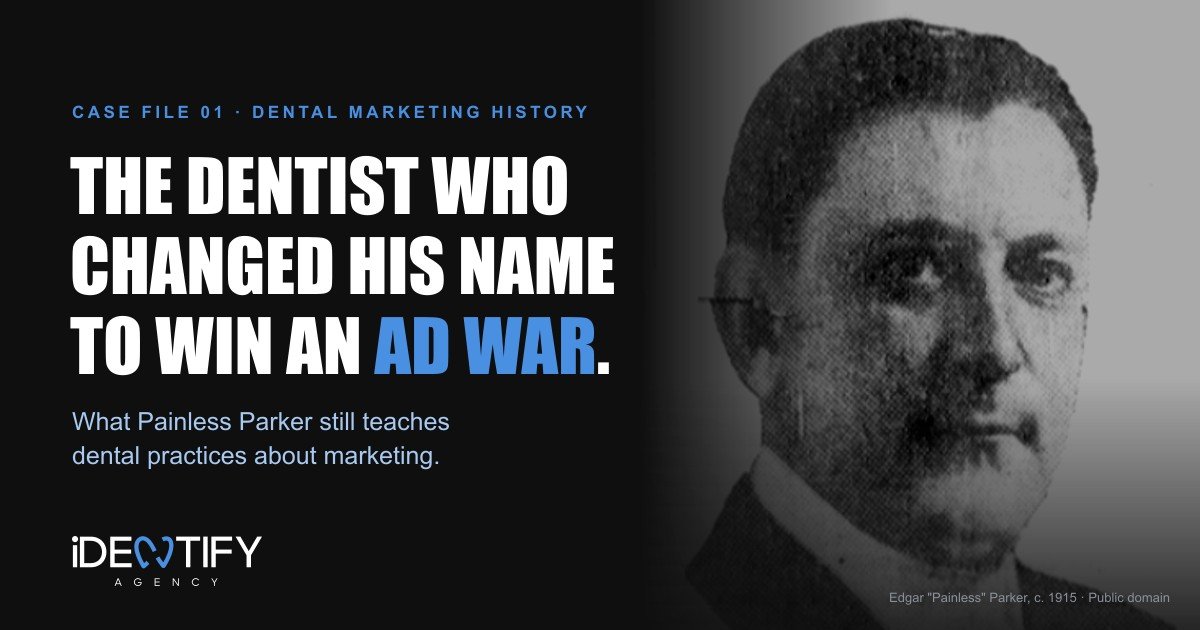
In 1915, a dentist accused of false advertising for promising “painless” extractions found an unusual way out. He went to court and made Painless his legal first name.
Edgar Randolph Parker is the most outrageous figure in the history of dental marketing. He is also the most useful one to study. Almost every tactic dentists argue about today, from advertising to patient reviews to multi-location brands, has a version in his story. So does every ethical rule that now governs how practices are allowed to market.
This is what he did, what was actually true, and what a modern practice should take from it.
A profession that refused to advertise
Parker graduated from the Philadelphia Dental College, now Temple University’s Kornberg School of Dentistry, in 1892. At the time, soliciting patients was considered unethical. According to Smithsonian Magazine, six weeks into practice, he still had not seen a single patient.
His fix was to advertise anyway. He bartered a set of dentures with a sign maker for a placard reading “Painless Parker”. His offer was simple: a 50-cent extraction that would be painless, or he would pay the patient $5.
The insight behind it was sound. Patients avoided dentists because they feared pain. Parker built his entire brand around removing that fear.
The dental circus
In 1913, Parker partnered with William Beebe, a former employee of P.T. Barnum, to launch a travelling dental circus, Smithsonian reports. There was a brass band, costumed performers and a dental chair on stage. Parker wore a top hat and a necklace said to hold the 357 teeth he pulled in a single day.
The show drew crowds. It was also staged. Smithsonian describes a planted audience member who “proved” the extraction was painless. When real patients took the chair, Parker tapped his foot to cue the band to play louder and drown out their screams. His numbing agent, a diluted cocaine solution he called “hydrocaine”, only sometimes worked.
We broke this story down frame by frame on Instagram. See Case File 01 on @identify.agency.
The name change and the empire
Regulators eventually accused Parker of false advertising: dentistry could not honestly be called painless. In 1915 he legally changed his first name to Painless, according to Wikipedia’s account and Smithsonian. Every sign that reads “Painless Parker” is now named a person rather than making a claim.
The business scaled. He opened 28 dental offices across the Western United States (Smithsonian puts it at about 30), employed 75 dentists among more than 240 staff, sold his own line of mouthwash and toothpaste, and grossed about $3 million a year, per Wikipedia. Dentistry Today traces today’s chains, franchise dentistry and dental advertising straight back to him.
His own print ads were just as theatrical. A 1916 full-page ad in the Tacoma Times, now in the public domain, is written in the voice of a tooth: “Harken! to the Voice of the Tooth.”
The backlash that shaped dental ethics
The profession hated him. The American Dental Association called Parker “a menace to the dignity of the profession.” He was sued many times and lost his licence in several states. Temple’s dean told Smithsonian that “any positive patient stories are likely to be fake.”
That backlash had lasting effects. The ADA’s ban on advertising has been held for decades. It only changed after the U.S. Supreme Court ruled in Bates v. State Bar of Arizona (1977) that professional advertising is protected speech when it is not misleading. The ADA revised its code of ethics on advertising on April 27, 1979, after a settlement with the Federal Trade Commission, as Dentaltown recounts.
Smithsonian’s verdict is fair: Parker was “a huckster and, arguably, a con man”, yet in a backwards way, “a founding father of good dental practices”. The rules he broke are the ones that now protect patients.
What a modern practice should take from Painless Parker
1. Market against the real objection. Parker understood that fear, not price or distance, kept patients away. Most practice marketing still lists services instead of answering the question patients are actually asking. Find the objection that stops your patients from booking, whether that is cost, judgement or time, and build your message around it.
2. Proof beats claims, but the proof has to be real. Parker’s genius was demonstrated. His failure was that the demonstration was faked. Today the equivalent of the circus stage is video, before-and-after cases and patient reviews. Each one is powerful when it is genuine and documented with consent. Each one poses a legal risk if it is not genuine and documented with consent.
3. A name is a strategy. “Painless Parker” told patients exactly what they were buying. Most dental brands are named after an owner or a street. Your name, tagline and first line of website copy should state the outcome patients want.
4. Visibility without systems does not last. Parker could fill a fairground, but his reputation followed him from state to state. Attention only turns into a durable practice when the experience, the follow-up and the reviews hold up afterwards.
5. Ethics is a growth strategy. The ADA code that grew partly out of Parker’s excesses now requires that dental advertising not be “false or misleading in a material respect”, a standard the ADA extended to social media influencers in 2025. Practices that market honestly do not just avoid penalties. They build the trust that makes every other channel cheaper.
How iDENTIFY helps dental practices market boldly and honestly
Parker had the instinct for attention and none of the systems or ethics to sustain it. iDENTIFY is built to give practitioners both.
We are a dental-only marketing agency with 15 years of operational experience inside US dental practices. We work across nine connected areas, including search visibility, paid growth, reputation and reviews, brand and creative, and the systems that stop leads leaking between the first call and the chair. Every claim we help you make is one you can stand behind.
If you want to know what your marketing is really proving to patients, book a 20-minute diagnostic audit. No contracts, no exit fees.
Sources
Every figure in both pieces comes from one of these pages, each opened and checked on 19 October 2026.
- Smithsonian Magazine, “A Brief History of America’s Most Outrageous Dentist” (Dec 2016): 1892 graduation, no patients after six weeks, 50-cent extraction and $5 guarantee, 1913 circus with William Beebe, staged demonstrations, 1915 name change, about 30 clinics, ADA “menace” quote, “huckster” and “founding father” quotes, Temple museum artifacts.
- Wikipedia, “Painless Parker”: 28 Western US offices, 75 dentists, 240+ staff, $3 million a year, 357 teeth in one day, and death in 1952.
- Dentistry Today, “It All Started With Painless Parker” (2022): Parker as the origin of chains and dental advertising.
- Wikimedia Commons, 1916 Tacoma Times ad and 1915 portrait: public-domain images.
- Dentaltown, “Professional Courtesy: Painful Advertising” (Nov 2013): The ADA code was revised on advertising on April 27, 1979, after an FTC settlement.
- Wikipedia, “Bates v. State Bar of Arizona”: 1977 ruling protecting non-misleading professional advertising.
- ADA News, code update on social media influencers (Feb 24, 2025): “false or misleading in a material respect” standard and influencer disclosure.
- Cornell LII, 45 CFR 164.508: HIPAA authorisation required for marketing uses of PHI.
- FTC press release, final rule banning fake reviews (Aug 14, 2024): prohibited review practices and civil penalties.
- Google, Prohibited and restricted content policy: bans on review gating, incentives, staff quotas and requests for specific content.
- HHS OCR, New Vision Dental settlement (Dec 2022): $23,000 for disclosing PHI in review responses.
- BrightLocal, Local Consumer Review Survey 2025 (Jan 29, 2025): 4% never read reviews; 42% trust reviews like personal recommendations (79% in 2020); 42% see incentivised reviews as fake.
- Pew Research Center (Jul 22, 2025): 8% vs 15% click rates, 1% clicks on cited sources, 60% of question searches triggered a summary.
