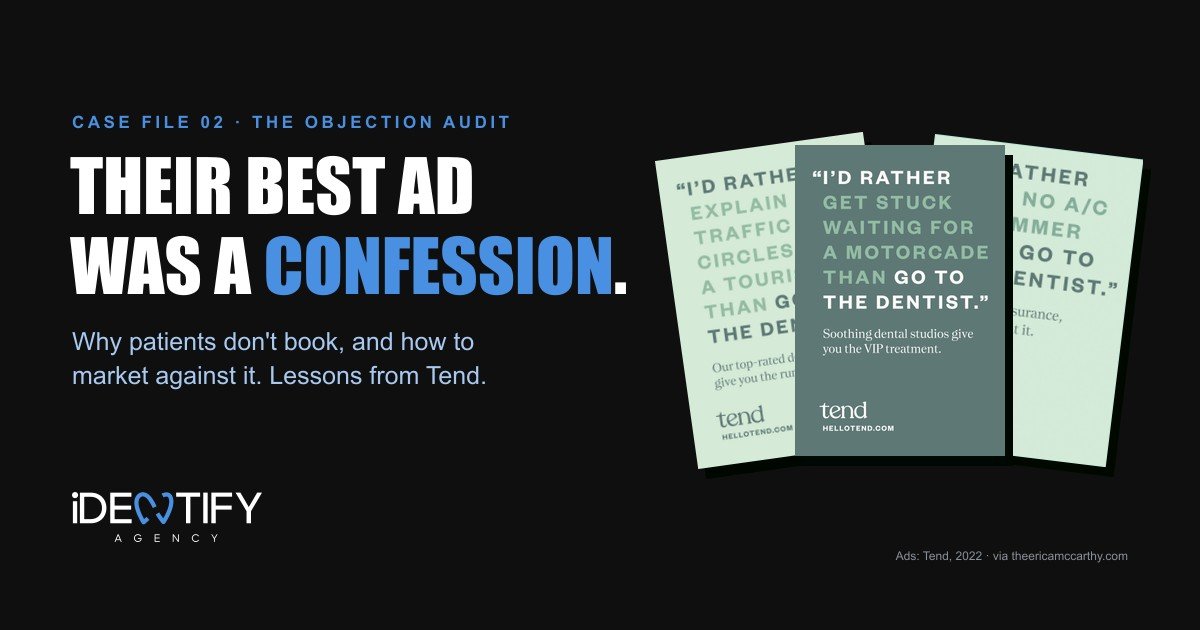
One of the most effective dental ads of the last few years did not mention a single treatment. It read: “I’d rather negotiate with my landlord than go to the dentist.”

The line ran on the New York City subway for Tend, a dental group founded in 2019. It worked because it said out loud what most patients think and most practices never acknowledge. This post is about how to do the same thing for your own practice, without a subway budget.
We broke this story down frame by frame on Instagram. See Case File 02 on @identify.agency.
Your real competitor is avoidance
Most dental marketing is written as if patients are choosing between dentists. Many are choosing between a dentist and no dentist at all.
In CareQuest Institute’s 2022 national survey of nearly 6,000 adults, more than half of those with an oral health problem did not seek care, and a quarter of them said they could not afford it. Among adults who had not seen an oral health provider in two years, 27% cited cost.
Fear is the other constant. A 2021 meta-analysis in the Journal of Dentistry, pooling 31 studies and 72,577 adults, estimated that 15.3% of adults worldwide live with dental fear and anxiety, and 3.3% with severe fear. It was more common among women and younger adults.
Then there are the objections no survey captures well: the lecture about flossing, the embarrassment of having stayed away for years, the time off work, the surprise bill. Patients rarely say these out loud. They simply do not book.
What Tend did differently
Tend’s first out-of-home campaign started from one insight, described in the campaign case study: people would rather do almost anything else than go to the dentist. So the team wrote first-person confessions of exactly that, and paired each one with something Tend did about it.
The structure is worth studying line by line:
- “I’d rather negotiate with my landlord than go to the dentist.” Payoff: “Easy online booking gives you a new lease on dental.”
- “I’d rather be running late on a local train than go to the dentist.” Payoff: “Our convenient dental appointments fit your busy schedule.”
- “I’d rather change a flat on the Longfellow Bridge than go to the dentist.” Payoff: “We’re pumped about booking dental visits online.”
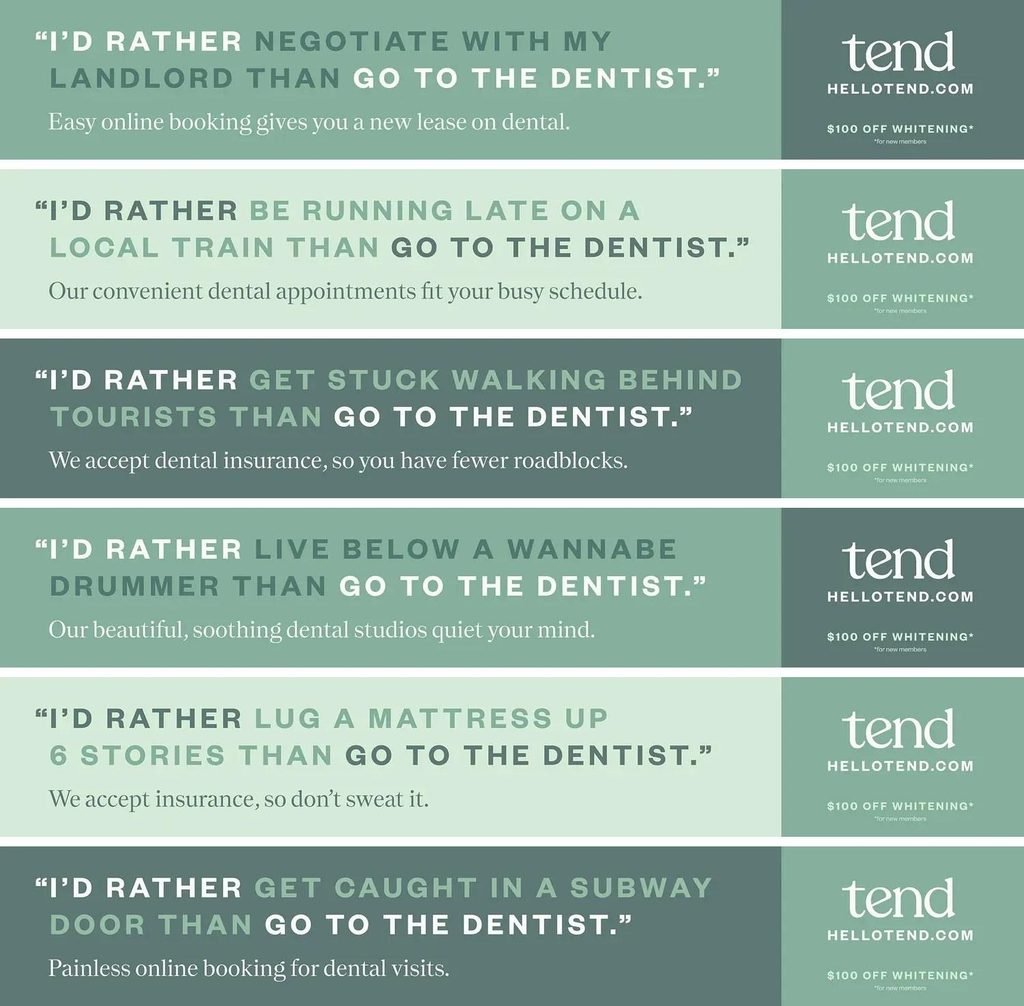
Six of Tend’s NYC subway car cards. Every payoff line answers a different objection: booking, time, insurance, the studio itself. Image: Tend, via the Tend Brand Campaign case study (theericamccarthy.com).
Every payoff answers a real barrier
Read all fourteen subway, D.C. and Boston units in the case study and a pattern appears. By our count, four payoff lines answer anxiety about the visit itself (“soothing dental studios”), three answer cost and insurance (“We accept insurance, so don’t sweat it”), three answer booking friction (“Painless online booking”), three answer time (“convenient appointment times”), and one answers trust (“Our top-rated dentists won’t give you the runaround”).
That is almost exactly the list of reasons people give for avoiding the dentist. The jokes changed with every city. The objections did not.
Localized for every city
The copy was rewritten for each market. Washington D.C. riders on bike share stations read about motorcades, traffic circles, switching parties and Beltway traffic.
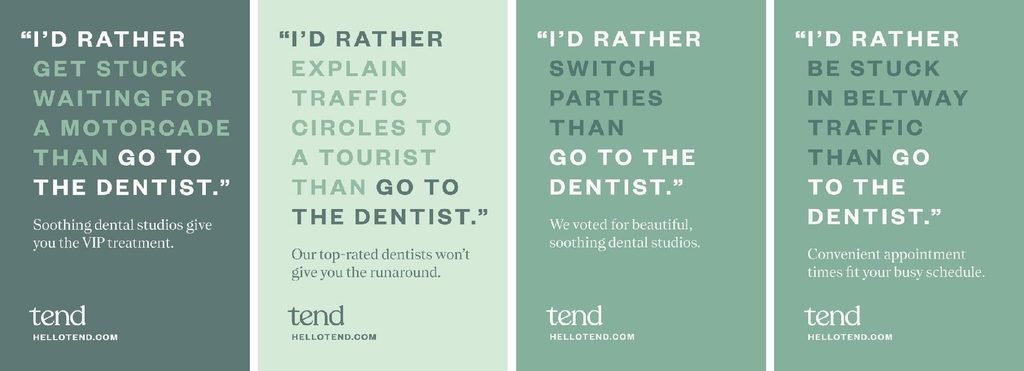
Tend’s Washington D.C. bike share units: motorcades, traffic circles, politics and the Beltway. Image: Tend, via the Tend Brand Campaign case study (theericamccarthy.com).
Boston bus shelters swapped in lobster rolls, summers without A/C, waiting for the bus and the swim to Provincetown. A billboard ran over Boston streets with the Longfellow Bridge line.
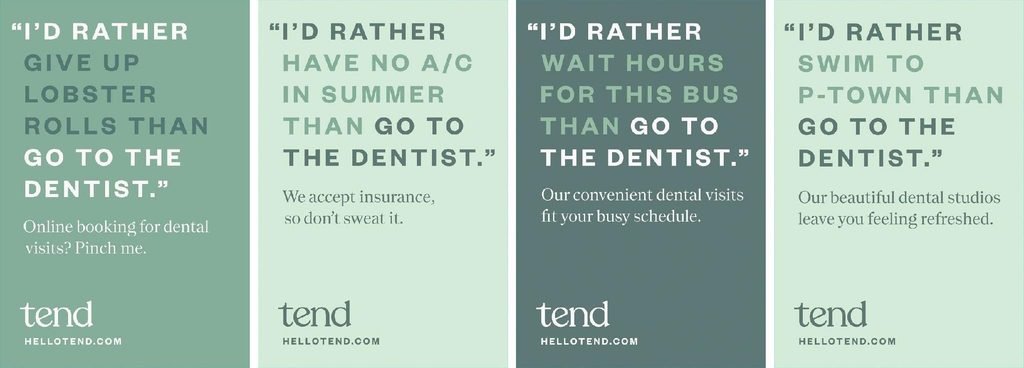
Tend’s Boston bus shelter posters. Image: Tend, via the Tend Brand Campaign case study (theericamccarthy.com).
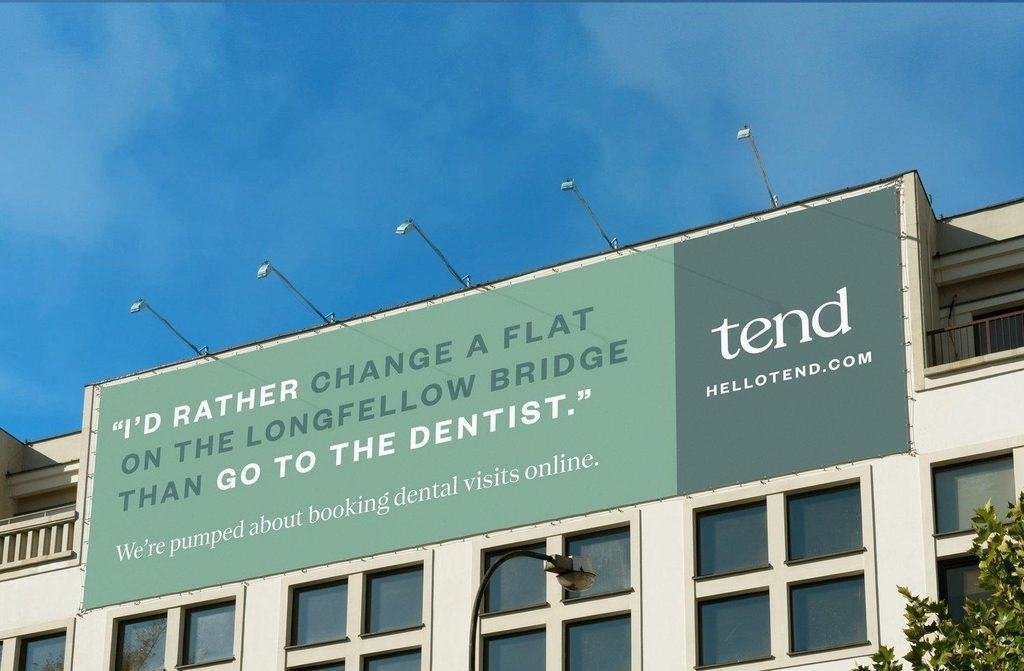
Tend’s Boston billboard: “I’d rather change a flat on the Longfellow Bridge than go to the dentist.” Agency presentation image. Image: Tend, via the Tend Brand Campaign case study (theericamccarthy.com).
On Instagram, the same idea became a “Would you rather?” story sequence: swim with a shark, hold a snake, kiss an eel, or see the dentist. The punchline: “If you picked the shark, the snake, or the eel, we’ve got a dentist you should meet.”
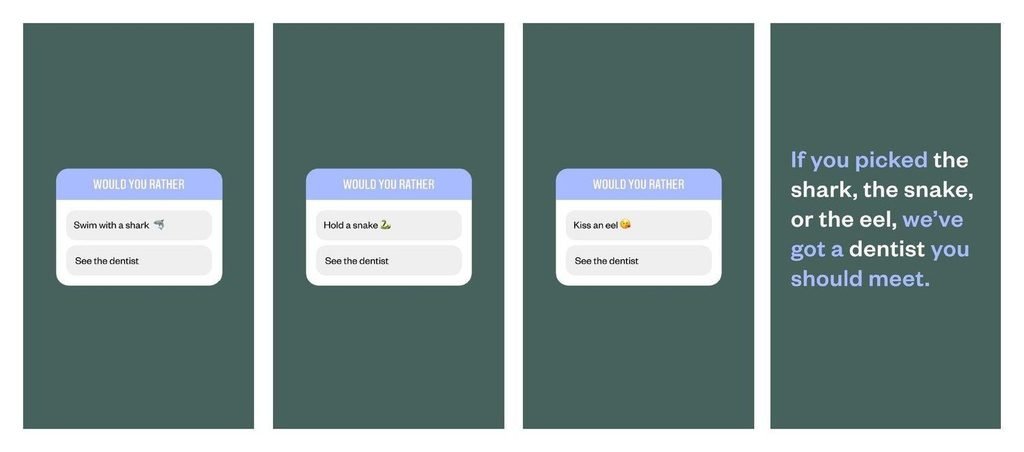
Tend’s Instagram Stories: a “Would you rather?” poll turned into a reason to book. Image: Tend, via the Tend Brand Campaign case study (theericamccarthy.com).
You can watch the 29-second connected TV spot and see every placement on the campaign case study page. Creative credits: copy and concept by TJ DiFrancesco, art direction by Shanna Greenberg, design by Emma Olswing and Natalie Nardello, video production by MNTN by Quickframe.
The campaign only worked because the studio delivered
Humor gets attention. It does not get a second visit. Tend’s studios were built to back up the ads: according to the Boston Globe, patients get a ceiling screen showing a show of their choice, noise-canceling headphones, a TV that greets them by name, flavored toothpaste and a numbing gel reformulated to taste better. There is a separate room for money conversations.
The same report notes a waitlist of more than 3,000 people before Tend’s first Boston studios opened, revenue growth of 400% between 2020 and 2021, 20 studios across New York, Washington and Atlanta, and a $125 million funding round. Those results came from the campaign and the experience together, not the copywriting alone.
How to run an objection audit in your own practice
You do not need Tend’s budget to use Tend’s method. You need to know your patients’ objections better than your competitors do, and be willing to name them.
- Collect the objections in patients’ own words. Listen to recorded new-patient calls, read your reviews and your competitors’ reviews, and ask your front desk what people say when they hesitate or cancel. Write down the exact phrases.
- Group and rank them. Most practices find the same five or six: cost and insurance confusion, fear of pain, embarrassment about how long it has been, time off work, a bad past experience, and not knowing what to expect.
- Write the confession. Put each objection in the first person, the way a patient would say it to a friend. “I haven’t been in six years and I’m embarrassed” is more persuasive than “We welcome patients of all backgrounds.”
- Pair it with a real fix. Every confession needs a concrete answer you already deliver: transparent fees before treatment, evening hours, online booking, a no-lecture first visit, sedation options. If you cannot name the fix, solve the operational problem before you advertise it.
- Put it where the decision happens. Your Google Business Profile description, the first screen of your website, ad headlines, appointment reminders and the front-desk phone script should all answer the top objection, not list your services.
- Measure what changes. Track call-to-booking rate, new-patient bookings and no-shows before and after. The right message shows up in conversion, not likes.
Two guardrails
Laugh with patients, never at them. Tend’s ads joke about the dentist, not about the patient. Copy that mocks someone’s teeth or habits reinforces the judgment that keeps them away.
Promise only what is true. If your ad says “no surprise bills,” your billing process has to guarantee it. Dental advertising must not be false or misleading in a material respect under the ADA code, and patient stories need written consent. We covered those rules in Case File 01 on Painless Parker.
How iDENTIFY helps
An objection audit sits right where marketing meets operations, and that is where iDENTIFY works. We are a dental-only agency with 15 years of operational experience inside US dental practices. We help practices find the objections in their calls, reviews and data; turn them into messaging for search, ads and their Google Business Profile; and fix the follow-up and booking systems so the promise holds when the patient calls.
What objection is your practice too polite to name? Book a 20-minute diagnostic audit and we will help you find it. No contracts, no exit fees.